Aah, I remember when Hard-Disks held the advantages of lower cost and higher capacity.
Well, at least they have lower cost (for now, and this was announce in August 2018!).
IBM And Everspin Announce 19TB NVMe SSD With MRAM Write Cache
https://www.anandtech.com/show/13174/ibm-and-everspin-announce-19tb-nvme-ssd-with-mram-write-cache
Saturday, March 9, 2019


Wednesday, May 2, 2018
Samsung EVO SSDs keep evolving!
I hear that the 970 model is also available in 2TB, nice!
I could have an SSD for C: AND D: and keep the capacious HDDs for backing storage.
Samsung 970-PRO-512GB and 970-EVO-250GB, 500GB, 1TB NVMe SSD Review
I could have an SSD for C: AND D: and keep the capacious HDDs for backing storage.
Samsung 970-PRO-512GB and 970-EVO-250GB, 500GB, 1TB NVMe SSD Review
Wednesday, February 21, 2018
Samsung makes an even bigger SSD
Samsung now has its 31TB SSD into manufacturing.
The 30.72TB PM1643 effectively replaces the current PM1633a and its 15.36TB capacity limit.
Read all about it here - https://www.theregister.co.uk/2018/02/20/samsung_30tb_ssd/ .
The 30.72TB PM1643 effectively replaces the current PM1633a and its 15.36TB capacity limit.
Read all about it here - https://www.theregister.co.uk/2018/02/20/samsung_30tb_ssd/ .
Friday, July 14, 2017
The roles of SSDs and HDDs are not what they were!
The days when SSDs were the small capacity but fast drives and HDDs were the slower but capacious drives are well and truly OVER!
Viking Technology is shipping a 50TB SAS SSD. Yes, you read that right.
Viking Technology is shipping a 50TB SAS SSD. Yes, you read that right.
Friday, October 21, 2016
Friday, March 4, 2016
HDDs are definitely not making performance or capacity improvements of this order.
A 15TB drive you can completely re-write every single day of it's five-year warranty life and not expect a failure.
Samsung ships the world's highest capacity SSD, with 15TB of storage
Now we just need better interfaces in our PCs to handle the 12Gb Serial Attached SCSI (SAS) interface.
Samsung ships the world's highest capacity SSD, with 15TB of storage
Now we just need better interfaces in our PCs to handle the 12Gb Serial Attached SCSI (SAS) interface.
Thursday, January 14, 2016
Seagate caught up pretty smartish
Just a month or so later Seagate has a 10 TB Helium-filled HDD to rival Western Digital's.
I'll be on the lookout for a comparison!
Seagate floats out 10TB HDD filled with lifting gas
I'll be on the lookout for a comparison!
Seagate floats out 10TB HDD filled with lifting gas
Thursday, December 3, 2015
A 10TB Helium-filled Disk-Drive WITHOUT shingling
I'll bet you thought I was done here, hey? No, just very busy this last year.
This seems like a sufficiently significant bit of news to warrant a quick mention though.
WDC's shingle-free stocking filler: A 10TB helium disk drive
The spec' is pretty amazing and available in PDF format Here.
Here's a quick rundown -
Western Digital Corporation (WDC) has updated its Ultrastar He8 to the He10, providing the same capacity as the shingled HGST Ultrastar Archive Ha10 announced in June but without the shingling, meaning standard write speeds.
Compared to the He8 it has 25 per cent more capacity, and WDC says it has a 56 per cent lower watts/TB rating than traditional air-filled HDDs, a 2.5 million hours MTBF (mean-time-between-failures) rating, and a five-year warranty.
The drive has a second-generation, dual-stage HGST Micro-Actuator to enhance tracking accuracy and reliability in multi-disk enclosures. It is said to be "drop-in ready for all mainstream enterprise capacity applications." This presumably, partly at least, explains why WDC can now get to the 10TB capacity level without having to shingle (partially overlap) tracks and incur the penalty of slower rewrite speeds.
It rotates at 7,200rpm and is a classic capacity-optimized drive, with a 256MB cache and 249MB/sec sustained transfer rate. The previous He8 had a 205MB/sec sustained transfer rate. It can have a 6Gbit/s SATA interface or a 12Gbit/s SAS one.
There are Instant Secure Erase (ISE) and Self-Encrypting Drive (SED) options and the disk is built for 24 x 7 operation. To increase reliability, it retains a previous firmware version for safer firmware updates.
I think that Santa could probably fit that in his sack without any problem.
This seems like a sufficiently significant bit of news to warrant a quick mention though.
WDC's shingle-free stocking filler: A 10TB helium disk drive
The spec' is pretty amazing and available in PDF format Here.
Here's a quick rundown -
Western Digital Corporation (WDC) has updated its Ultrastar He8 to the He10, providing the same capacity as the shingled HGST Ultrastar Archive Ha10 announced in June but without the shingling, meaning standard write speeds.
Compared to the He8 it has 25 per cent more capacity, and WDC says it has a 56 per cent lower watts/TB rating than traditional air-filled HDDs, a 2.5 million hours MTBF (mean-time-between-failures) rating, and a five-year warranty.
The drive has a second-generation, dual-stage HGST Micro-Actuator to enhance tracking accuracy and reliability in multi-disk enclosures. It is said to be "drop-in ready for all mainstream enterprise capacity applications." This presumably, partly at least, explains why WDC can now get to the 10TB capacity level without having to shingle (partially overlap) tracks and incur the penalty of slower rewrite speeds.
It rotates at 7,200rpm and is a classic capacity-optimized drive, with a 256MB cache and 249MB/sec sustained transfer rate. The previous He8 had a 205MB/sec sustained transfer rate. It can have a 6Gbit/s SATA interface or a 12Gbit/s SAS one.
There are Instant Secure Erase (ISE) and Self-Encrypting Drive (SED) options and the disk is built for 24 x 7 operation. To increase reliability, it retains a previous firmware version for safer firmware updates.
I think that Santa could probably fit that in his sack without any problem.
Thursday, November 6, 2014
Python 2.x.x AND Python 3.x.x on Windows
If you need to run both Python 2 AND Python 3 scripts on Windows, this is good to know -
https://stackoverflow.com/questions/15912063/how-do-i-run-python-2-and-3-in-windows-7
- also, check out section 3.4 here -
https://docs.python.org/3.3/using/windows.html
https://stackoverflow.com/questions/15912063/how-do-i-run-python-2-and-3-in-windows-7
- also, check out section 3.4 here -
https://docs.python.org/3.3/using/windows.html
Wednesday, September 10, 2014
Less than 1 month later!
So, 8 Terabyte was the newer hotness in August, now at the start of September HGST has a 10 (Terabyte drive ready! (But I still hate Shingled Magnetic Recording)
Whopping 10TB disks spin out of HGST – plus 3.2TB flash slabs
Whopping 10TB disks spin out of HGST – plus 3.2TB flash slabs
Wednesday, August 27, 2014
4 months later
So, 6 Terabyte was the new hotness in April, now at the end of August Seagate has an 8 Terabyte drive ready!
That 8TB Seagate MONSTER? It's HERE... Have a look (sans specs)
That 8TB Seagate MONSTER? It's HERE... Have a look (sans specs)
Tuesday, April 8, 2014
Just when I plan to catch up...
Most of my machines have 1TB drives and 2TB external backup drives.
I was thinking about moving to multiple Virtual Machines running on the desktop PC with a 4TB drive to hold the VMs and another for backups.
This means losing having the SSD as Windows 7 boot drive unless I get a bigger SSD for Windows 7 and the Hypervisor and keep Linux machines on a HDD.
Still, as of today I know what the server needs for VM backups - Seagate brings out 6TB HDD
Get a datasheet here (PDF).
I was thinking about moving to multiple Virtual Machines running on the desktop PC with a 4TB drive to hold the VMs and another for backups.
This means losing having the SSD as Windows 7 boot drive unless I get a bigger SSD for Windows 7 and the Hypervisor and keep Linux machines on a HDD.
Still, as of today I know what the server needs for VM backups - Seagate brings out 6TB HDD
Get a datasheet here (PDF).
Monday, March 3, 2014
Ten Songs Challenge
Well, I know at least 10 good songs that I always want to have around.
Finding near approximations to my home versions took a little longer, but here (in no particular order) you go!
Everlast - Ends
Massive Attack - I against I
Jean Elan - Where's your head at
Pink Floyd - Comfortably Numb
After Midnight Project - Take Me Home
Booker T. And The Mg's - Green Onions
Phil Collins - In The Air Tonight
M.I.A. - Paper Planes
Eddie Vedder with Nusrat Fateh Ali Khan - The long road (My version is 16:37 long)
Ng Pei Sin - Misty Heart (From my Mod collection, an XM actually)
I could easily do 100 if I had the time! Torley Wong and Madonna very nearly made the list for starters!
Finding near approximations to my home versions took a little longer, but here (in no particular order) you go!
Everlast - Ends
Massive Attack - I against I
Jean Elan - Where's your head at
Pink Floyd - Comfortably Numb
After Midnight Project - Take Me Home
Booker T. And The Mg's - Green Onions
Phil Collins - In The Air Tonight
M.I.A. - Paper Planes
Eddie Vedder with Nusrat Fateh Ali Khan - The long road (My version is 16:37 long)
Ng Pei Sin - Misty Heart (From my Mod collection, an XM actually)
I could easily do 100 if I had the time! Torley Wong and Madonna very nearly made the list for starters!
Saturday, February 8, 2014
The Omega-3 and B12 Myth
It looks like being vegetarian is good for health, but not necessarily longevity for many practitioners.
A Vegan explains some worrying study results for Meat-eaters, Vegetarians and Vegans.
It's a worthwhile 1 Hour 15 Minutes of nice explanations and tips that we can all use -
https://www.youtube.com/watch?v=q7KeRwdIH04
So, What foods are good for you?
Eggs? - Not really
Avocados? - If only
Coconut Oil? - Hell No
Garlic and Flavinoids? - at least vs Fish and white meat induced cancer in breast cells
Acia Berries or Pomegranate Juice? - Finally, a pretty positive result (if you can actually get them)!
A Vegan explains some worrying study results for Meat-eaters, Vegetarians and Vegans.
It's a worthwhile 1 Hour 15 Minutes of nice explanations and tips that we can all use -
https://www.youtube.com/watch?v=q7KeRwdIH04
So, What foods are good for you?
Eggs? - Not really
Avocados? - If only
Coconut Oil? - Hell No
Garlic and Flavinoids? - at least vs Fish and white meat induced cancer in breast cells
Acia Berries or Pomegranate Juice? - Finally, a pretty positive result (if you can actually get them)!
Thursday, October 17, 2013
Nicola Scafetta's paper passes peer review
"This paper contains a detailed analysis of all CMIP5 models used
by the IPCC, and demonstrates that they do not well reproduce the
decadal and multidecadal patterns since 1850 (not just the temperature
standstill since 2000, the failure is nearly total). The paper
extensively discusses my astronomical based model since the Medieval
Warm Period and demonstrates its far better performance than the CMIP5
models."
The PDF and an overview - Nicola Scafetta: Discussion on climate oscillations: CMIP5 general circulation models versus a semi-empirical harmonic model based on astronomical cycles
The PDF and an overview - Nicola Scafetta: Discussion on climate oscillations: CMIP5 general circulation models versus a semi-empirical harmonic model based on astronomical cycles
Sunday, March 11, 2012
The steady march of Time (keeping)
I am tidying up my email folders and came across a couple from 2002, here they are -
The nuclear clock outlined in a paper accepted for publication in Physics Letters Review would neither lose nor gain 1/20th of a second in 14 billion years, the age of the universe.
New Optical Clock
Promises More Accuracy than Cesium.
NIST researchers have demonstrated a new
kind of atomic clock that has the potential to be up to 1,000 times more
accurate than today’s best clock. The new clock is based on an energy
transition in a single trapped mercury ion (a mercury atom that is missing one
electron). Building a clock based on such a high-frequency transition was
previously impractical because it requires both “capturing” the ion and holding
it very still to get accurate readings, and having a mechanism that can “count”
the ticks accurately at such a high frequency.
The quality of a clock depends on its stability and accuracy—whether the clock provides a constant, unchanging output frequency, and how close the measured frequency is to the fundamental atomic resonance that provides the clock’s “tick.” One advantage of the new clock is that it ticks much faster. Today’s international time and frequency standards, such as NIST-F1, measure an atomic resonance of about 9 billion cycles per second. By contrast, the new NIST device monitors an optical frequency more than 100,000 times higher or about 1 quadrillion (US) cycles per second.
The quality of a clock depends on its stability and accuracy—whether the clock provides a constant, unchanging output frequency, and how close the measured frequency is to the fundamental atomic resonance that provides the clock’s “tick.” One advantage of the new clock is that it ticks much faster. Today’s international time and frequency standards, such as NIST-F1, measure an atomic resonance of about 9 billion cycles per second. By contrast, the new NIST device monitors an optical frequency more than 100,000 times higher or about 1 quadrillion (US) cycles per second.
And my follow up email (which still seems like a good idea to me) -
The Arithmetic Muse strikes...
I've just been musing
over that Quadrillion Hz clock a bit, and I knew straight off you'd want me to
share my musings ;-)
Basically in
US-speak, 'illions (I just made that word up) are 1000 * 1000 ^ prefix.
So,
Mono (1) gives 1000 * 1000 ^ 1 = Million,
Bi (2) gives 1000 * 1000 ^ 2 = Billion,
Tri (3) gives 1000 * 1000 ^ 3= Trillion,
Quad (4, should be Tetra to stay
Greek, I think) gives 1000 * 1000 ^ 4 = Quadrillion.
By the same logic,
Zero (0) gives 1000 * 1000 ^ 0 = the famous 'Zillion'
In which case, at a mere 1000, it
isn't so huge after all :-)
I propose we stick
with the classical languages and call Zero 'Null', therefore 1000 is a
'Nillion' which fits 'Nil' too.
Today, we have this -
Nuke clock incapable of losing time chimes with boffins
Precise to 1/20th of a sec in 14bn years
By Anna Leach The force that binds neutrons to an atom's nucleus could be used to
create clocks that are 100 times more accurate than today's best atomic
clocks, say physicists at the University of New South Wales (UNSW).The nuclear clock outlined in a paper accepted for publication in Physics Letters Review would neither lose nor gain 1/20th of a second in 14 billion years, the age of the universe.
The unprecedented accuracy of this new time-keeping comes from
linking the system to the orbit of a neutron within an atomic nucleus.
That makes it more accurate than atomic clocks, explains Professor
Victor Flambaum, Head of Theoretical Physics at UNSW.
Atomic clocks use the orbiting electrons of an atom as the clock pendulum. But we have shown that by using lasers to orient the electrons in a very specific way, one can use the orbiting neutron of an atomic nucleus as the clock pendulum, making a so-called nuclear clock with unparalleled accuracy....
Well, they have a theory, now they just have to figure out how to actually make such a clock!
Sunday, March 4, 2012
General: ABout My About My Prediction
Well, the Chevy Volt didn't last long!
Production was suspend March 2nd 2012 following disappointing sales.
The story is Here.
If this is typical of electric vehicle sales then at least the electricity providers will be spared rolling out new infrastructure.
Production was suspend March 2nd 2012 following disappointing sales.
The story is Here.
If this is typical of electric vehicle sales then at least the electricity providers will be spared rolling out new infrastructure.
Monday, January 10, 2011
General: About my 2009 prediction
In 2009 I predicted a change to 240 Volt power in the US to facilitate the large power demand for vehicle recharging.
At the 2011 CES in Las Vegas, General Electric had a stand showing their 'WattStation' charging a Chevrolet Volt.
The nice thing is that it is apparently a 240 Volt system :-)

AP writes "An attendee looks GE's new Residential WattStation plugged into a Chevrolet Volt electric car at the 2011 International Consumer Electronics Show January 8, 2011 in Las Vegas. The 240 volt Residential WattStation is intended to be installed at home and can charge a car in only 4-8 hours. The Residential WattStation will ship in the fall and is expected to retail for between UAD $1,000 to $1,500."
I have no idea what UAD are, but if they meant AUD then US is about the same.
Update: 20110119 -
The Register has an interesting story on the current (no pun intended) state of UK electric vehicle recharge infrastructure which has this interesting bit of information -
"... This is because e-car batteries can't be charged up at all quickly. Using a specialist 240V, 32-amp supply - representative of the sort of charging point that could be widespread very quickly, and the rating that its users' home charge points have - a Mini-E can recharge in 4½ hours. The maximum amperage it can take, according to the makers, is 48: thus the fastest it can possibly, theoretically be juiced up without damage is 3 hours. If the luckless Mini E driver is compelled to use a normal UK wall socket, it will take well in excess of 10 hours. ..."
The next paragraph dealing with the recharging of a Tesla Roadster is a bit of a horror story! It is well worth reading the whole article.
That's a lot of power to generate and distribute over a country to run a significant percentage of transport on electricity. I think that even the local distribution for that power will be at a lot more than 240V, probably with a small substation/transformer per cluster of recharge points.
At the 2011 CES in Las Vegas, General Electric had a stand showing their 'WattStation' charging a Chevrolet Volt.
The nice thing is that it is apparently a 240 Volt system :-)

AP writes "An attendee looks GE's new Residential WattStation plugged into a Chevrolet Volt electric car at the 2011 International Consumer Electronics Show January 8, 2011 in Las Vegas. The 240 volt Residential WattStation is intended to be installed at home and can charge a car in only 4-8 hours. The Residential WattStation will ship in the fall and is expected to retail for between UAD $1,000 to $1,500."
I have no idea what UAD are, but if they meant AUD then US is about the same.
Update: 20110119 -
The Register has an interesting story on the current (no pun intended) state of UK electric vehicle recharge infrastructure which has this interesting bit of information -
"... This is because e-car batteries can't be charged up at all quickly. Using a specialist 240V, 32-amp supply - representative of the sort of charging point that could be widespread very quickly, and the rating that its users' home charge points have - a Mini-E can recharge in 4½ hours. The maximum amperage it can take, according to the makers, is 48: thus the fastest it can possibly, theoretically be juiced up without damage is 3 hours. If the luckless Mini E driver is compelled to use a normal UK wall socket, it will take well in excess of 10 hours. ..."
The next paragraph dealing with the recharging of a Tesla Roadster is a bit of a horror story! It is well worth reading the whole article.
That's a lot of power to generate and distribute over a country to run a significant percentage of transport on electricity. I think that even the local distribution for that power will be at a lot more than 240V, probably with a small substation/transformer per cluster of recharge points.
Saturday, November 13, 2010
mbed - Big Boys Arduino!
Hack-a-day described mbed as "Arduino. On steroids. With claws and fangs.", what's not to like about that?
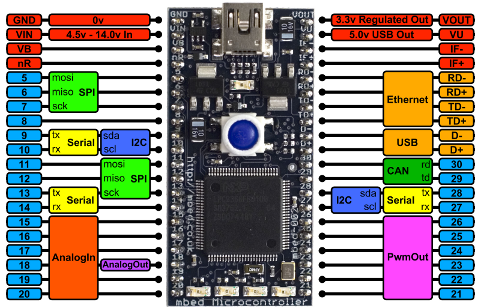
The mbed is a small module with 0.1" pins for mounting on a breadboard. It has an NXP (Philips) LPC1768 Cortex M3 ARM 100 MHz processor which has 512KB Flash, 64KB RAM and a stack of goodies including Ethernet, USB OTG, SPI, I2C, UART, CAN, PWM, ADC, DAC and GPIO (ordinary General Purpose I/O pins).

The development tools are unusual in that you don't install anything, when you register your shiny new mbed, you get an account with your own workspace and access to the web-based compiler and libraries.
To register, you just hook the mbed up to a USB port on your PC (cable provided) and click on the MBED.HTM file in the flash-drive that appears (being web-based it works for Windows, Linux and Mac of course). Less than a minute later (if you have a user name thought up) you can be set up and ready to go.
To run the demo 'Blinking LED' program just click on the download button and save it to the flash-drive your mbed appears to be. Press the reset button on the mbed and 'Presto!' the latest file to be downloaded is executed, it really is that easy.
The demonstration video to show the power and ease of development is well worth watching.
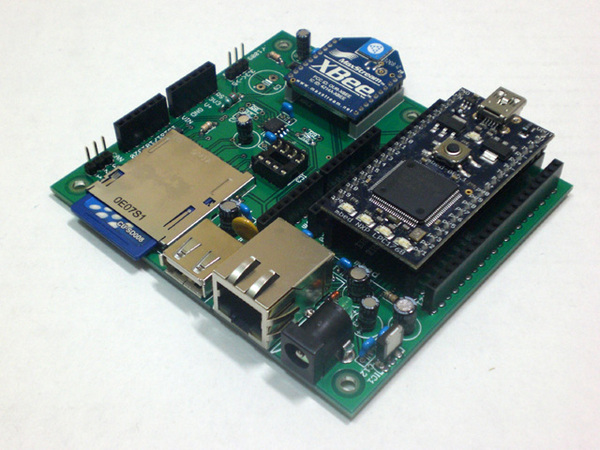
Anyway, the thing is that it looks like someone has made an mbed to Arduino Shield adaptor, so connecting to various ready-made peripherals should soon be even easier.

Considering the no-hassle compiler and libraries are free, the mbed is a quite reasonable proposition for dipping your toe in the ARM embedded development waters at about the same price as the far less powerful Arduino Nano.
I got mine from Element 14 (formerly Farnell) for about AUD $87.
The mbed is a small module with 0.1" pins for mounting on a breadboard. It has an NXP (Philips) LPC1768 Cortex M3 ARM 100 MHz processor which has 512KB Flash, 64KB RAM and a stack of goodies including Ethernet, USB OTG, SPI, I2C, UART, CAN, PWM, ADC, DAC and GPIO (ordinary General Purpose I/O pins).
To register, you just hook the mbed up to a USB port on your PC (cable provided) and click on the MBED.HTM file in the flash-drive that appears (being web-based it works for Windows, Linux and Mac of course). Less than a minute later (if you have a user name thought up) you can be set up and ready to go.
To run the demo 'Blinking LED' program just click on the download button and save it to the flash-drive your mbed appears to be. Press the reset button on the mbed and 'Presto!' the latest file to be downloaded is executed, it really is that easy.
The demonstration video to show the power and ease of development is well worth watching.
Anyway, the thing is that it looks like someone has made an mbed to Arduino Shield adaptor, so connecting to various ready-made peripherals should soon be even easier.
Considering the no-hassle compiler and libraries are free, the mbed is a quite reasonable proposition for dipping your toe in the ARM embedded development waters at about the same price as the far less powerful Arduino Nano.
I got mine from Element 14 (formerly Farnell) for about AUD $87.
Sunday, October 10, 2010
Virtualisation for Beginners
I recently learnt that Dr Dobbs Journal is no more, having just become a sub-section of Network World.
This prompted me to go pick up the article code ZIPs from the old web-site to trawl for any useful bits.
I pointed my Getright Browser Tool at - ftp://66.77.27.238/sourcecode/ddj/ and downloaded the lot (1.31GB of zip files) while it is still there.
Amongst the goodies I found that I had downloaded a zipped image for a Ubuntu Dot.Net Development virtual machine.
I put this Zip and the FREE VMPlayer from VMWare onto an old 786MB / 40GB / AGP video Pentium PC running fully up-to-date XP SP3.
Honestly, there are probably better machines hardware-wise put out for recycle at the side of the road.
I unpacked the 1GB ZIP which became about 11GB on account of a 10GB disk image in there.
I installed and ran the VMPlayer and was happy to see that it actually ran OK on such a low-spec machine and handled the wireless 11n NIC OK.
I tried to run the Ubuntu virtual machine but if failed as it was created to run as a 2-CPU machine though luckily only with 512MB RAM.
I changed the VM settings (so easy that the cat could do it) to 1 CPU and away it went.
Then VMPlayer announced that my Linux VMWare Toolkit was out of date and offered to fix it up while I was still using the Ubuntu VM.
I accepted and the tools were downloaded verified and mounted so that they suddenly appeared as a CD inside the Ubuntu VM, Impressive!
I opened the .tar.gz tools archive file on the CD and dragged the contents to my home/user directory and they were uneventfully extracted.
I then ran the enclosed .pl install script and voila, my Ubuntu virtual machine is all updated with the latest VMWare tools.
Now I can play with Ubuntu Dot.Net development any time I want without having another old PC hanging around.
Actually, I’m tempted to get VM Workstation and make a VM of the old XP machine so that I can run IT under Windows 7 in the future.
And NO I won’t even try and run Ubuntu in VMWare in the virtual XP machine, I’ll make a separate Ubuntu machine. :-)
So, two take-aways from this –
- Getting a hands-on taste of Virtualisation is cheap and easy, and…
- You don’t need a high-end machine to experiment on (and get some Virtualisation experience you can claim when job-hunting).
Have a go! :-)
Subscribe to:
Posts (Atom)
