It looks like being vegetarian is good for health, but not necessarily longevity for many practitioners.
A Vegan explains some worrying study results for Meat-eaters, Vegetarians and Vegans.
It's a worthwhile 1 Hour 15 Minutes of nice explanations and tips that we can all use -
https://www.youtube.com/watch?v=q7KeRwdIH04
So, What foods are good for you?
Eggs? - Not really
Avocados? - If only
Coconut Oil? - Hell No
Garlic and Flavinoids? - at least vs Fish and white meat induced cancer in breast cells
Acia Berries or Pomegranate Juice? - Finally, a pretty positive result (if you can actually get them)!
Saturday, February 8, 2014


Thursday, October 17, 2013
Nicola Scafetta's paper passes peer review
"This paper contains a detailed analysis of all CMIP5 models used
by the IPCC, and demonstrates that they do not well reproduce the
decadal and multidecadal patterns since 1850 (not just the temperature
standstill since 2000, the failure is nearly total). The paper
extensively discusses my astronomical based model since the Medieval
Warm Period and demonstrates its far better performance than the CMIP5
models."
The PDF and an overview - Nicola Scafetta: Discussion on climate oscillations: CMIP5 general circulation models versus a semi-empirical harmonic model based on astronomical cycles
The PDF and an overview - Nicola Scafetta: Discussion on climate oscillations: CMIP5 general circulation models versus a semi-empirical harmonic model based on astronomical cycles
Sunday, March 11, 2012
The steady march of Time (keeping)
I am tidying up my email folders and came across a couple from 2002, here they are -
The nuclear clock outlined in a paper accepted for publication in Physics Letters Review would neither lose nor gain 1/20th of a second in 14 billion years, the age of the universe.
New Optical Clock
Promises More Accuracy than Cesium.
NIST researchers have demonstrated a new
kind of atomic clock that has the potential to be up to 1,000 times more
accurate than today’s best clock. The new clock is based on an energy
transition in a single trapped mercury ion (a mercury atom that is missing one
electron). Building a clock based on such a high-frequency transition was
previously impractical because it requires both “capturing” the ion and holding
it very still to get accurate readings, and having a mechanism that can “count”
the ticks accurately at such a high frequency.
The quality of a clock depends on its stability and accuracy—whether the clock provides a constant, unchanging output frequency, and how close the measured frequency is to the fundamental atomic resonance that provides the clock’s “tick.” One advantage of the new clock is that it ticks much faster. Today’s international time and frequency standards, such as NIST-F1, measure an atomic resonance of about 9 billion cycles per second. By contrast, the new NIST device monitors an optical frequency more than 100,000 times higher or about 1 quadrillion (US) cycles per second.
The quality of a clock depends on its stability and accuracy—whether the clock provides a constant, unchanging output frequency, and how close the measured frequency is to the fundamental atomic resonance that provides the clock’s “tick.” One advantage of the new clock is that it ticks much faster. Today’s international time and frequency standards, such as NIST-F1, measure an atomic resonance of about 9 billion cycles per second. By contrast, the new NIST device monitors an optical frequency more than 100,000 times higher or about 1 quadrillion (US) cycles per second.
And my follow up email (which still seems like a good idea to me) -
The Arithmetic Muse strikes...
I've just been musing
over that Quadrillion Hz clock a bit, and I knew straight off you'd want me to
share my musings ;-)
Basically in
US-speak, 'illions (I just made that word up) are 1000 * 1000 ^ prefix.
So,
Mono (1) gives 1000 * 1000 ^ 1 = Million,
Bi (2) gives 1000 * 1000 ^ 2 = Billion,
Tri (3) gives 1000 * 1000 ^ 3= Trillion,
Quad (4, should be Tetra to stay
Greek, I think) gives 1000 * 1000 ^ 4 = Quadrillion.
By the same logic,
Zero (0) gives 1000 * 1000 ^ 0 = the famous 'Zillion'
In which case, at a mere 1000, it
isn't so huge after all :-)
I propose we stick
with the classical languages and call Zero 'Null', therefore 1000 is a
'Nillion' which fits 'Nil' too.
Today, we have this -
Nuke clock incapable of losing time chimes with boffins
Precise to 1/20th of a sec in 14bn years
By Anna Leach The force that binds neutrons to an atom's nucleus could be used to
create clocks that are 100 times more accurate than today's best atomic
clocks, say physicists at the University of New South Wales (UNSW).The nuclear clock outlined in a paper accepted for publication in Physics Letters Review would neither lose nor gain 1/20th of a second in 14 billion years, the age of the universe.
The unprecedented accuracy of this new time-keeping comes from
linking the system to the orbit of a neutron within an atomic nucleus.
That makes it more accurate than atomic clocks, explains Professor
Victor Flambaum, Head of Theoretical Physics at UNSW.
Atomic clocks use the orbiting electrons of an atom as the clock pendulum. But we have shown that by using lasers to orient the electrons in a very specific way, one can use the orbiting neutron of an atomic nucleus as the clock pendulum, making a so-called nuclear clock with unparalleled accuracy....
Well, they have a theory, now they just have to figure out how to actually make such a clock!
Sunday, March 4, 2012
General: ABout My About My Prediction
Well, the Chevy Volt didn't last long!
Production was suspend March 2nd 2012 following disappointing sales.
The story is Here.
If this is typical of electric vehicle sales then at least the electricity providers will be spared rolling out new infrastructure.
Production was suspend March 2nd 2012 following disappointing sales.
The story is Here.
If this is typical of electric vehicle sales then at least the electricity providers will be spared rolling out new infrastructure.
Monday, January 10, 2011
General: About my 2009 prediction
In 2009 I predicted a change to 240 Volt power in the US to facilitate the large power demand for vehicle recharging.
At the 2011 CES in Las Vegas, General Electric had a stand showing their 'WattStation' charging a Chevrolet Volt.
The nice thing is that it is apparently a 240 Volt system :-)

AP writes "An attendee looks GE's new Residential WattStation plugged into a Chevrolet Volt electric car at the 2011 International Consumer Electronics Show January 8, 2011 in Las Vegas. The 240 volt Residential WattStation is intended to be installed at home and can charge a car in only 4-8 hours. The Residential WattStation will ship in the fall and is expected to retail for between UAD $1,000 to $1,500."
I have no idea what UAD are, but if they meant AUD then US is about the same.
Update: 20110119 -
The Register has an interesting story on the current (no pun intended) state of UK electric vehicle recharge infrastructure which has this interesting bit of information -
"... This is because e-car batteries can't be charged up at all quickly. Using a specialist 240V, 32-amp supply - representative of the sort of charging point that could be widespread very quickly, and the rating that its users' home charge points have - a Mini-E can recharge in 4½ hours. The maximum amperage it can take, according to the makers, is 48: thus the fastest it can possibly, theoretically be juiced up without damage is 3 hours. If the luckless Mini E driver is compelled to use a normal UK wall socket, it will take well in excess of 10 hours. ..."
The next paragraph dealing with the recharging of a Tesla Roadster is a bit of a horror story! It is well worth reading the whole article.
That's a lot of power to generate and distribute over a country to run a significant percentage of transport on electricity. I think that even the local distribution for that power will be at a lot more than 240V, probably with a small substation/transformer per cluster of recharge points.
Saturday, November 13, 2010
mbed - Big Boys Arduino!
Hack-a-day described mbed as "Arduino. On steroids. With claws and fangs.", what's not to like about that?
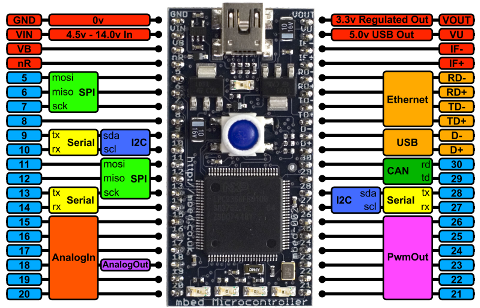
The mbed is a small module with 0.1" pins for mounting on a breadboard. It has an NXP (Philips) LPC1768 Cortex M3 ARM 100 MHz processor which has 512KB Flash, 64KB RAM and a stack of goodies including Ethernet, USB OTG, SPI, I2C, UART, CAN, PWM, ADC, DAC and GPIO (ordinary General Purpose I/O pins).
The development tools are unusual in that you don't install anything, when you register your shiny new mbed, you get an account with your own workspace and access to the web-based compiler and libraries.
To register, you just hook the mbed up to a USB port on your PC (cable provided) and click on the MBED.HTM file in the flash-drive that appears (being web-based it works for Windows, Linux and Mac of course). Less than a minute later (if you have a user name thought up) you can be set up and ready to go.
To run the demo 'Blinking LED' program just click on the download button and save it to the flash-drive your mbed appears to be. Press the reset button on the mbed and 'Presto!' the latest file to be downloaded is executed, it really is that easy.
The demonstration video to show the power and ease of development is well worth watching.
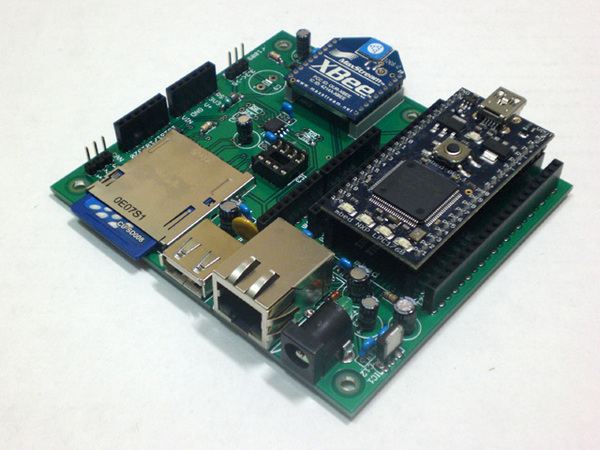
Anyway, the thing is that it looks like someone has made an mbed to Arduino Shield adaptor, so connecting to various ready-made peripherals should soon be even easier.
Considering the no-hassle compiler and libraries are free, the mbed is a quite reasonable proposition for dipping your toe in the ARM embedded development waters at about the same price as the far less powerful Arduino Nano.
I got mine from Element 14 (formerly Farnell) for about AUD $87.
The mbed is a small module with 0.1" pins for mounting on a breadboard. It has an NXP (Philips) LPC1768 Cortex M3 ARM 100 MHz processor which has 512KB Flash, 64KB RAM and a stack of goodies including Ethernet, USB OTG, SPI, I2C, UART, CAN, PWM, ADC, DAC and GPIO (ordinary General Purpose I/O pins).
To register, you just hook the mbed up to a USB port on your PC (cable provided) and click on the MBED.HTM file in the flash-drive that appears (being web-based it works for Windows, Linux and Mac of course). Less than a minute later (if you have a user name thought up) you can be set up and ready to go.
To run the demo 'Blinking LED' program just click on the download button and save it to the flash-drive your mbed appears to be. Press the reset button on the mbed and 'Presto!' the latest file to be downloaded is executed, it really is that easy.
The demonstration video to show the power and ease of development is well worth watching.
Anyway, the thing is that it looks like someone has made an mbed to Arduino Shield adaptor, so connecting to various ready-made peripherals should soon be even easier.
Considering the no-hassle compiler and libraries are free, the mbed is a quite reasonable proposition for dipping your toe in the ARM embedded development waters at about the same price as the far less powerful Arduino Nano.
I got mine from Element 14 (formerly Farnell) for about AUD $87.
Sunday, October 10, 2010
Virtualisation for Beginners
I recently learnt that Dr Dobbs Journal is no more, having just become a sub-section of Network World.
This prompted me to go pick up the article code ZIPs from the old web-site to trawl for any useful bits.
I pointed my Getright Browser Tool at - ftp://66.77.27.238/sourcecode/ddj/ and downloaded the lot (1.31GB of zip files) while it is still there.
Amongst the goodies I found that I had downloaded a zipped image for a Ubuntu Dot.Net Development virtual machine.
I put this Zip and the FREE VMPlayer from VMWare onto an old 786MB / 40GB / AGP video Pentium PC running fully up-to-date XP SP3.
Honestly, there are probably better machines hardware-wise put out for recycle at the side of the road.
I unpacked the 1GB ZIP which became about 11GB on account of a 10GB disk image in there.
I installed and ran the VMPlayer and was happy to see that it actually ran OK on such a low-spec machine and handled the wireless 11n NIC OK.
I tried to run the Ubuntu virtual machine but if failed as it was created to run as a 2-CPU machine though luckily only with 512MB RAM.
I changed the VM settings (so easy that the cat could do it) to 1 CPU and away it went.
Then VMPlayer announced that my Linux VMWare Toolkit was out of date and offered to fix it up while I was still using the Ubuntu VM.
I accepted and the tools were downloaded verified and mounted so that they suddenly appeared as a CD inside the Ubuntu VM, Impressive!
I opened the .tar.gz tools archive file on the CD and dragged the contents to my home/user directory and they were uneventfully extracted.
I then ran the enclosed .pl install script and voila, my Ubuntu virtual machine is all updated with the latest VMWare tools.
Now I can play with Ubuntu Dot.Net development any time I want without having another old PC hanging around.
Actually, I’m tempted to get VM Workstation and make a VM of the old XP machine so that I can run IT under Windows 7 in the future.
And NO I won’t even try and run Ubuntu in VMWare in the virtual XP machine, I’ll make a separate Ubuntu machine. :-)
So, two take-aways from this –
- Getting a hands-on taste of Virtualisation is cheap and easy, and…
- You don’t need a high-end machine to experiment on (and get some Virtualisation experience you can claim when job-hunting).
Have a go! :-)
Thursday, March 25, 2010
General: My Obesity Solution
Here is a passing thought I will share with you.
The media and doctors are all brow-beating us about how the population is becoming obese.
Well surely, if so many people are becoming obese, then it should be time to redraw the height/weight scales that are used to determine 'normal'.
If you think that would be cheating consider this - the scales currently in use were derived post-war after years of rationing where people barely saw sugar or butter or any sizable piece of meat, is that fair? Is it pure coincidence or artistic incompetence that paintings and books from previous centuries depict a great many portly people? (Think 'Pickwick Papers').
I think that losing weight might be a good plan, but I am not convinced that we are being judged fairly.
Others doubt the BMI too!
Update: A nice kicking for BMI on The Register -'Being fat is no worse for you than being a woman'
Friday, January 29, 2010
General: Embedded Development
Unless you are manufacturing your own line of products, embedded development starts with a customer wanting to create or improve a new or existing product.
Then follows a lot of question and answer and,l usually, research to identify the possible range of solutions, from off-the-shelf to fully-custom, and consider their respective strengths and weaknesses.
If it seems to both parties that a custom solution is the best option, you may have work to do, if the business matters are agreeable to you both.
Then, in theory, begins the thinking and design of a possible solution, although in practice quite a few possibilities will usually have occurred to the designer during the discovery phase.
The next step is fleshing out the component parts of the overall solution, which may start as no more than a few quickly drawn ideas, like so -

These rough ideas are frequently tested by the designer, either as components, or as a part of a whole solution. Whilst the older method is to build test hardware, a lot of people opt for simulation nowadays.
In order to produce the prototype, the schematic designs must be entered into the design tool and parts created and added to the library if it does not contain the required part, or not one in the required physical package.

When the complete schematic is entered and verified for electrical consistency, the board layout can be performed. An important first step here is entering the manufacturing capabilities of the PCB company as a set of design rules that your board must conform to.

When the layout is complete, a set of files can be sent to the PCB manufacturer and a small batch of prototype boards ordered. It can typically take 5-10 days to receipt of the finished boards, although speedier options exist for higher prices.
 This board is mostly Surface-Mount, apart from power devices all lined up to share a common heatsink and the much cheaper through-hole electrolytic capacitors. The hardest-to-solder ARM processor goes on first to give unimpeded access to it!
Once the prototype is fully debugged, actual assembly will be performed at the PCB manufacturers, but for the prototype it's a job for a good eye and a steady hand.
Once all parts are fitted, the board can be fitted into the prototype hardware and then the software programming and debugging can commence!

In this case, a JTAG port makes software development and testing much easier.
Larger size photo's can be viewed in this Flickr set.
Saturday, January 23, 2010
Subscribe to:
Posts (Atom)
